






A holographic fan, a journey from the lab to the Prime Minister’s podium
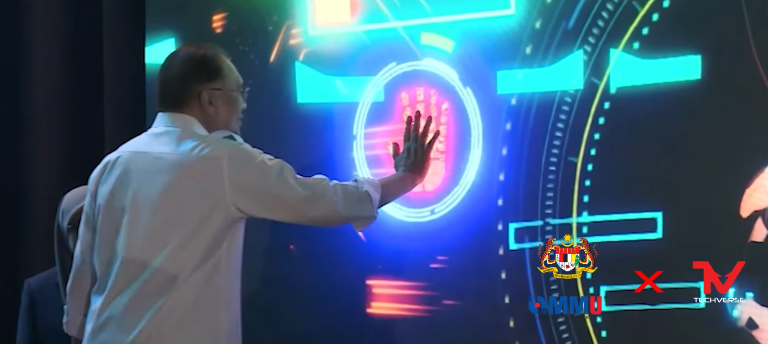
At a high-profile government event in Kuala Lumpur, Malaysia, Malaysian Prime Minister Anwar Ibrahim slowly placed his palm on an interactive screen – the screen immediately responded, with lights and shadows flowing, causing a stir among the audience. Behind this tangible interactive LED screen is a small team led by young entrepreneurs. The team’s name is TechVerse Productions, and the helmsman is a young man who recently graduated from university, Teoh Sing Jian.
No investors. No startup capital. No one telling him “yes.”
He just started like that.
An engineering student who is not content with just writing code
The story begins when Sing Jian chose his university major.
Initially, he took basic IT courses, and his days were routine — learning programming, logic, and building systems. But one thought constantly swirled in his mind: “Backend engineers and software developers create things that are precise but invisible. I want to create something that makes people’s eyes light up.”
So, he made a decision that seemed somewhat strange to others: turning to an emerging direction that integrates IT with multimedia—Creative Tech, specializing in virtual reality (VR) development.
“When I also need 3D modeling skills, material rendering skills, and programming with a game engine, that’s when I feel, this is what I want.”
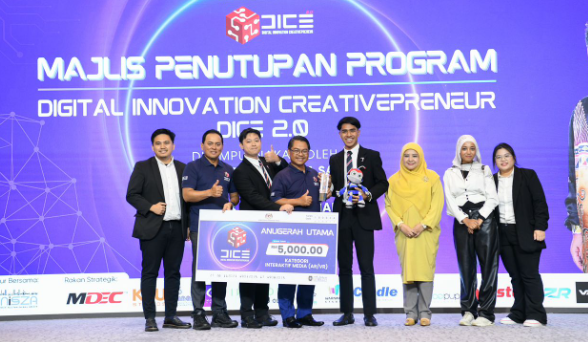
In the three years that followed, Sing Jian didn’t just bury himself in books. He participated in over ten competitions across Malaysia and Southeast Asia, winning first and second places in several of them. One of these was held in Indonesia, with participants from many top universities in Singapore, Malaysia, and other countries. After the competition, a mentor from Singapore approached him and asked a question that stunned him:
You’ve won so much, why do you keep competing? Haven’t you been recognized enough?
He didn’t have an answer then. But he took the question back to Malaysia, into long deliberations, and into countless late-night talks with his mentors—until TechVerse Productions was born.
Bootstrap: Use the first project to feed the next one
Many people, when talking about starting a business, first ask, “How much money do I need?” Sing Jian’s first question was, “I’ll go find a project first.”
“My company’s startup capital was zero,” he said, not with regret, but purely as a statement.
He started by taking on freelance projects, building up his portfolio, and gradually “formalizing” fragmented freelance work—registering a company, establishing a brand image, and consistently posting industry-related content on Instagram and LinkedIn, so that everyone who saw his profile would feel: this is a serious team, not a college student playing around with packaging.
The professional image led to the first milestone: a collaboration invitation from Malaysia Airports. It was a large event called “LINE Leaders,” and Sing Jian and his team were responsible for all creative technology support. The event concluded successfully, the project payment was received, and TechVerse used this money to purchase its first batch of hardware equipment—including the Hologram Fan, which is still in use today.
Subsequently, another company, Sigma, proactively approached them and commissioned them to develop a prototype AI Agent system in the form of an advance payment. This “MoU (Memorandum of Understanding)” model allowed Sing Jian to obtain research and development funds without equity dilution.
“They pay, we prototype, and they sell it to other companies. I don’t get a cut from that deal, but I get funding and experience.”
This way, project by project, TechVerse gradually gained a foothold.
What exactly is “Creative Technology”?
Laypeople often simply categorize TechVerse as a “VR company,” a misconception Sing Jian has to correct every time.
We call ourselves ‘Creative Tech’ because we do much more than just VR.
TechVerse’s current core business covers:
- AR/VR Application Development: Customized for businesses, used for employee training, product display, and event experience
- 3D Animation and VFX Visual Effects: For Brand Communication and Event Presentation
- Immersive Tech R&D: Application Exploration of Cutting-Edge Technologies
- Holographic Fan Content Production: Import brand animations into a spinning fan, making images “float” in the air
- Interactive device deployment: Interactive screens for Prime Minister’s activities as mentioned above
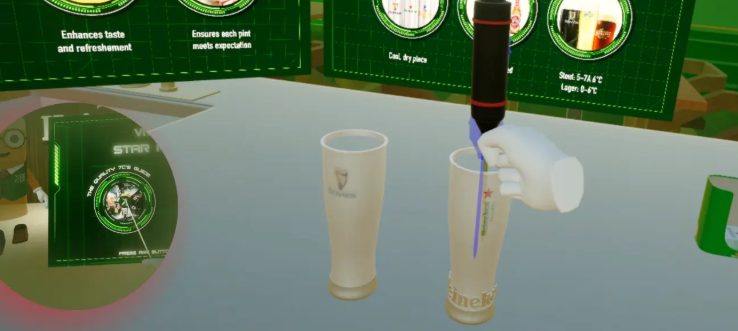
One of the most notable works he is proud of comes from Heineken Malaysia. They fully customized a VR simulation application for Heineken, accurately restoring the brand’s knowledge of beer brewing, including even the detail of “tilting 45 degrees to pour beer,” which was fully incorporated into the application’s interactive experience.
The list of collaborative clients also includes: Malaysia Airlines, Pentagon Malaysia, and most recently, the French Embassy — the latter invited the Sing Jian team for technical support during an international event for Francophone authors, which also allowed him to attend a cocktail party at the French Embassy in Kuala Lumpur, forging new connections at the intersection of diplomacy and culture.
As a university student, how does one earn the trust of Malaysian airports and the government?
This is a question many people will inevitably ask after hearing Sing Jian’s story.
After all, you’re just a freshly graduated student, how could they entrust the company’s image to you?
Sing Jian’s answer was concise and powerful, with only two core words: trust.
Trust begins with image. TechVerse’s Instagram and LinkedIn never post irrelevant content; every post points to the industry, to professionalism, and to capability. “You need to make the other party feel that this is a mature team.”
Trust comes from early networking. During university, Sing Jian didn’t just study; he served as a student representative, was active in off-campus non-profit organizations, and participated in various inter-university activities. “When I started my business, many of the classmates who participated in activities with me were already working as system managers or business analysts in large companies. They knew me and trusted me.”
Trust is built on a portfolio. At a certain stage, connections become secondary, and your portfolio becomes the most powerful endorsement. “People are already actively emailing to inquire about services; there’s no need to rely on connections to get in the door every time.”
This path of “first building an image, then building connections, and finally relying on works to survive independently” is the most sincere advice he gives to all students.
Challenges: Cost contradiction, Chinese competition, and scale bottleneck
Sing Jian has never hidden the challenges he faces.
First contradiction: How can low prices and full customization coexist?
TechVerse’s current competitive strategy is: lower prices than large companies while offering fully customized services. But deep customization means higher labor costs and time investment—two things that are logically at odds. Sing Jian’s answer is: at this stage, prioritize building industry recognition over maximizing profits. “Once the company can consistently earn RM200,000 per month, then we can talk about scaling up and increasing prices.”
Second major pressure: the potential entry of Chinese competitors
Currently, almost all holographic fans and other hardware used by TechVerse come from the Chinese supply chain. Once Chinese creative technology companies directly enter the Malaysian market, they will simultaneously have the advantages of both hardware and software, and their cost structure will be far lower than that of local teams. Sing Jian frankly admits that this is his concern, but his strategy is to deepen localization, utilizing his understanding of Malaysia’s diverse cultural festivals, rapid response capabilities to local customers, and long-term accumulated trust relationships to build a moat.
Third consideration: Outsource first, don’t rush to expand
Most entrepreneurs’ first reaction when talking about growth is “hiring people.” Sing Jian’s approach, however, is the exact opposite.
Currently, TechVerse has only one to two full-time employees, specializing in design and visual production, allowing him to focus on programming and business development. In addition, he extensively relies on part-timers and freelancers to handle project demands.
I think that during the stage of not yet having a stable monthly income, full-time employees are a fixed cost pressure. But project volume fluctuates—this month there might be three big cases, next month maybe only one. The advantage of freelancers is flexibility: when a project comes, I can quickly assemble the team needed; when the project ends, the cost also returns to zero.
There is a deeper consideration behind this. The creative technology industry has a wide variety of project types. A holographic launch event requires animators, while a VR training system requires game engine programmers. The talent requirements for the two are completely different. Instead of maintaining a fixed team trying to cover all skills, it is better to establish a reliable outsourcing network and call on them as needed.
My current goal is to get the company running and establish a stable cash flow first. Once I have enough guaranteed monthly income, I’ll then consider expanding the full-time team—at that stage, adding manpower will be solidifying the foundation, not gambling.
This “light staffing, heavy networking” talent strategy has allowed TechVerse to maintain extreme flexibility in its early stages with limited resources, and also reflects Sing Jian’s consistent judgment on the pace of entrepreneurship: it’s not about not expanding, but expanding when the cost of expansion is controllable.
Fourth Bottleneck: Timing for Scaling
“Many companies, upon receiving government subsidies, rush to expand, but these subsidies come with strict application conditions – for example, they must have been operating for at least three years.” Sing Jian is currently focusing his efforts on subsidy programs for which they are truly eligible, while continuously building exposure through events and competitions. The team currently has one to two full-time employees responsible for design, he personally leads programming and business development, and has begun to establish a “producer-creative team” layered collaboration structure.
“VR is not the end point”: A sober prediction of technological evolution
When talking about the future of VR, Sing Jian showed a calmness beyond his years.
“I believe VR will still exist in five years, used for scenarios like simulation training. But it’s not the final form. More mature and commercially viable technologies will emerge in the future, just like radio to black and white TV, then to color TV, and then to headphones – each generation of technology is the foundation for the next.”
He interpreted this as an opportunity rather than a threat: “That’s why you need to start now. When that new technology comes out, only those who understand VR will be able to handle it. If you keep waiting, you’ll have to start from scratch then.”
He is using his actions to validate this logic: enter before the technology matures, exchanging a library of works for future influence.
A word for entrepreneurs
As the interview was drawing to a close, I asked Sing Jian: If you could only give one piece of advice to university students preparing to start their own business, what would it be?
He thought for a moment and said:
Go to hackathons, go to competitions. That’s where you validate your idea at the lowest cost. But don’t stop at competitions—use that idea to find real investors, to find a real market, and truly bring it to fruition.
Then he paused for a second and added:
Start now. Don’t wait for the perfect moment.
Postscript
At the end of the interview, Sing Jian was already discussing the next project: in May, he will assist a company in creating a VR simulation experience at TRX (The Exchange TRX), though the specific client is currently confidential.
His schedule is booked for the next six months.
For a “bootstrapped” founder, this is probably the best proof.
🚫 Copyright Notice: Unauthorized reproduction, modification, or plagiarism is strictly prohibited.
