





On September 18, 2024, Tupperware Brands Corporation and its subsidiaries officially filed for Chapter 11 bankruptcy protection in Delaware. Today, I want to share my deep dive into this iconic brand, exploring its history, strategies, and the lessons learned from its downfall.
1. The Progenitor of Airtight Containers: The Rise of Tupperware
In the post-WWII era, chemist Earl Tupper—the founder of Tupperware—discovered the potential of Polyethylene while working at DuPont. At the time, this was essentially industrial waste used for wartime radar insulation. Through refining and innovation, Tupper transformed it into a lightweight, flexible, and unbreakable plastic.
However, the true breakthrough was the “Burping Seal” invented in 1946, inspired by the rim of a paint can. By pressing the lid to expel air, it created a vacuum seal that significantly extended food freshness. In an era when refrigerators were not yet universal, this solved a major “leftover” pain point for households.
2. Commercial Strategy: The Pioneer of Social Commerce
Despite a superior product, Tupperware initially failed in department stores. Consumers were skeptical of plastic safety and puzzled by the specific technique required to operate the seal. This proves that innovative products often carry the heavy burden of “market education.”
Enter Brownie Wise, a single mother and exceptional salesperson who was eventually appointed VP of Marketing. Wise was a pioneer of modern “Social Commerce.” She realized that Tupperware needed demonstration and, more importantly, trust. Consequently, Tupperware pulled out of retail and established the “Tupperware Party” direct-sales model.
This model succeeded on two psychological fronts:
- Experiential Trust: In a living room setting, throwing a liquid-filled bowl into the air to prove its seal was a dramatic “live validation” that erased consumer doubt.
- Social Pressure & Reciprocity: By wrapping commerce in a social gathering, participants weren’t just shoppers; they were friends of the host. Driven by the desire to support the host (who earned commissions or gifts), participants felt a social obligation to purchase.
Between the 1950s and 80s, Tupperware inadvertently tapped into a massive pool of female labor. In a time of limited career options, it provided housewives a path to financial independence without fixed hours. This success, however, led to a dogmatic belief in the model that would eventually become the company’s undoing.
3. The Warning Signs
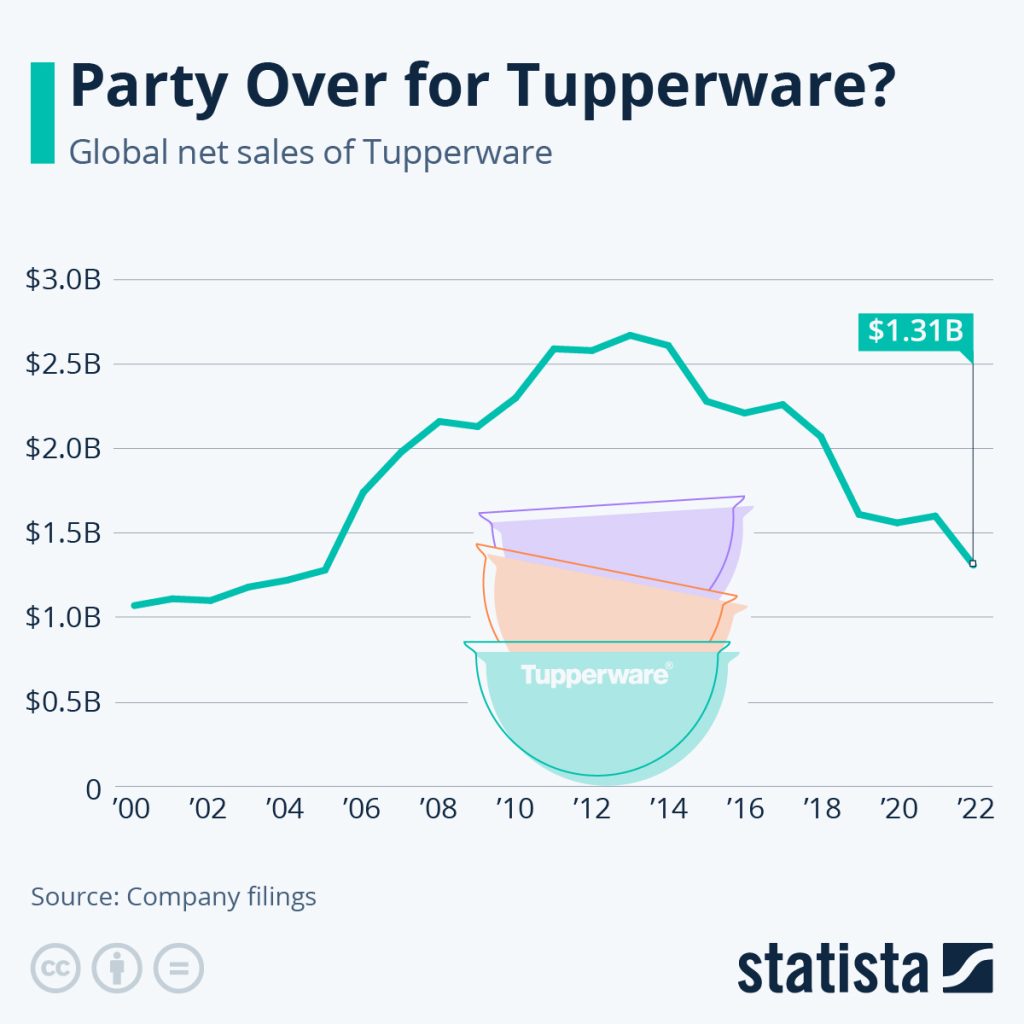
Tupperware’s decline wasn’t sudden; it was a decade-long hemorrhage. Revenue peaked in 2013 at $2.67 billion, with shares near $100. By 2023, revenue had withered to approximately $1.1 billion.
4. Why Did the Glory Fade?
According to my analysis, there are three primary reasons:
- The Collapse of the Social Foundation: The “full-time housewife” and “tight-knit neighborhood” pillars of the 21st century have eroded. As women entered the workforce, multi-hour afternoon parties became impractical. Furthermore, social circles moved online, making “door-to-door” or “living room” sales feel like an intrusive social offense. Tupperware clung to this dying channel, missing the E-commerce boom.
- The Innovator’s Dilemma & Channel Conflict: Management feared that selling on Amazon or Target would cannibalize the sales of their loyal direct-selling consultants. This overprotection of the legacy channel resulted in the loss of the growth market.
- Delayed Omnichannel Attempts: When Tupperware finally entered Target and Amazon in 2022, it was too late. Without the “demonstration halo,” Tupperware was just an expensive plastic box sitting next to cheaper competitors like Rubbermaid or OXO. Its brand positioning was lost.
- The “Plastic” Sin: Today, “Tupperware” is synonymous with plastic—a liability in an eco-conscious world. Younger generations (Millennials and Gen Z) are shifting toward glass, stainless steel, and silicone due to concerns over BPA and microplastics.
5. The Aftermath: Restructuring
Tupperware has pivoted from a public auction to a sale to its creditors (including Stonehill Capital and Alden Global). They agreed to waive $63 million in debt and provide $23.5 million in cash to acquire the brand. The business will transition to a new entity called Party Products LLC, aiming for a “startup mindset” focused on digital-first strategies in core markets like the US, Brazil, and China.
Conclusion
Tupperware’s story is a cautionary tale of sluggishness: slow to react to social shifts, slow to adopt technology, and slow to align with changing consumer values. This is a mirror for many SMEs in Malaysia who remain intoxicated by past successes while the world moves on.
I am Eric Wong. See you in the next corporate failure analysis.
