





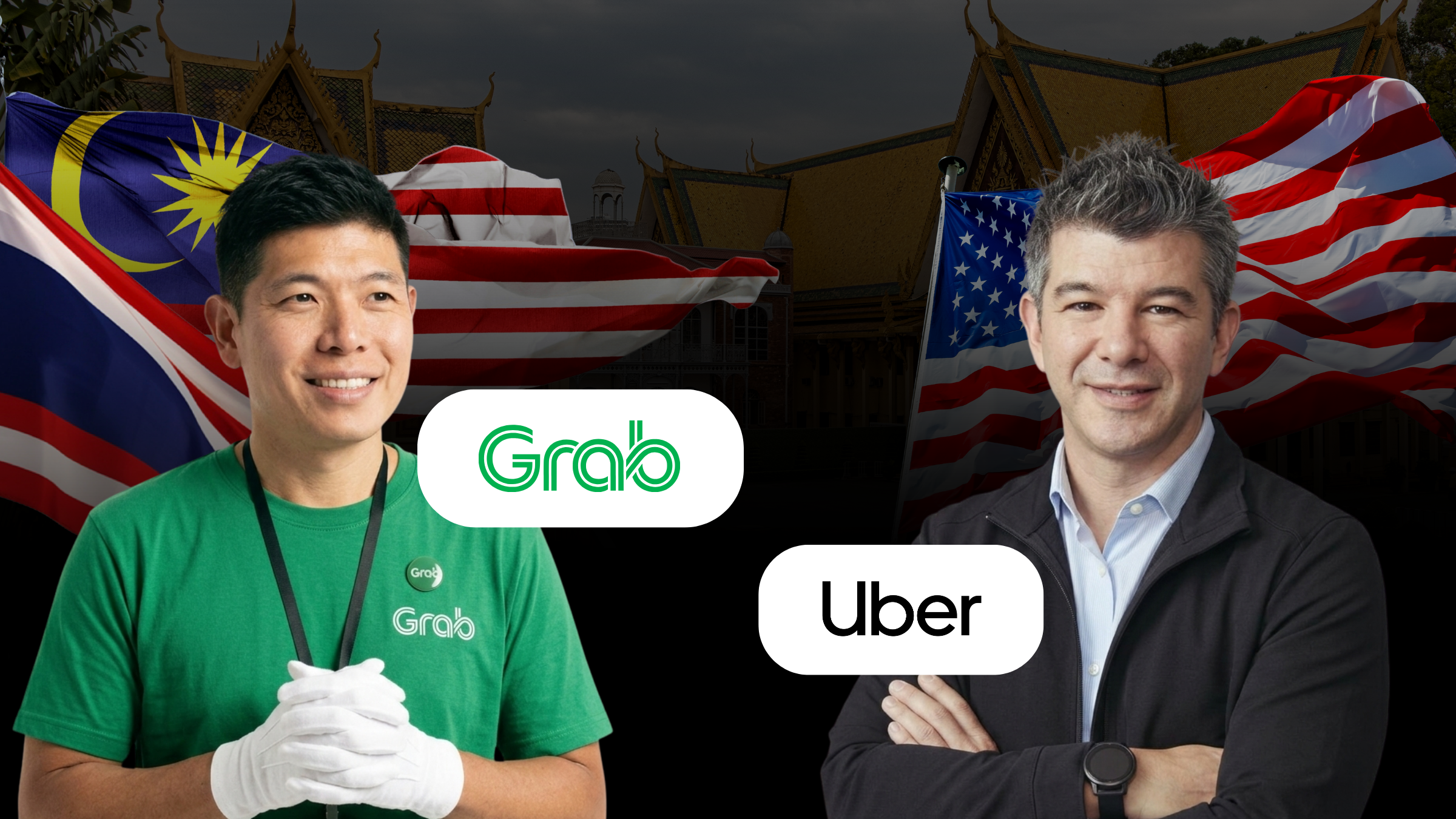
Uber’s loss to Grab in Malaysia (and throughout Southeast Asia), which ultimately led to its withdrawal in 2018, is a classic case in business history.
Hi everyone, I’m Eric Wong. In this episode today, I’m going to share with you why Uber, once the big brother among global ride-hailing services, was eventually surpassed by Grab in the Southeast Asian market. What did Uber do wrong? What did Grab do right? Today, we’re going to review that.
Ultimate Localization
Grab founder Anthony Tan is Malaysian, and he was very aware of the pain points in the Southeast Asian market, and proposed corresponding solutions.
- Payment methods: In Uber’s early days in Malaysia, a credit card had to be linked for payment. However, at that time in Southeast Asia, credit card usage online was not widespread. Grab was the first to introduce cash payments, directly eliminating the barrier for users.
- Vehicle adaptation: Grab started with GrabTaxi, rapidly expanding by partnering with existing taxi drivers, while Uber mainly focused on private cars, which at the time caused huge legal disputes and strong resistance from the taxi industry. In addition, in Thailand and other places, Grab even caters to local people’s travel habits, launching GrabBike service: electric bicycles, motorcycle taxis, and Tuk-tuk rides, showing that it has done a good job of localization.
- Relatable marketing: Grab often launches localized campaigns (e.g., GrabDurian durian delivery service), while Uber’s marketing leans towards a high-end, Western elite style, targeting white-collar workers, and is perceived as less relatable than Grab. However, the ride-hailing industry ultimately thrives on cost-effectiveness; whoever offers lower prices will win more users.
Ecosystem Building (Super App Strategy)
Grab realized early on that it would be difficult for the platform to become profitable in Southeast Asia based solely on ride-hailing services.
Thus, they quickly expanded their business to food delivery (GrabFood), express delivery (GrabExpress), and most crucially, financial payments (GrabPay).
When Grab became a “super app,” user stickiness was extremely high, and each service funneled traffic to other features, while effectively reducing customer acquisition costs. Although Uber later launched UberEats, it was a step behind in terms of ecosystem integration speed.
“Local Dragon” vs. “Global Giant” Resource War
Many entrepreneurs think it’s a pipe dream for a small company to beat industry giants, but I don’t think so. It’s true that large companies have a first-mover advantage and, due to a larger user base, can easily achieve economies of scale, lower costs, and have more resources to subsidize and fight wars of attrition. However, small companies often have greater freedom and focus.
For Grab, Southeast Asia is its entirety; but for Uber, Southeast Asia is just one piece on its global map. Therefore, I believe that entrepreneurs should not immediately want to provide a solution that can solve problems for the whole world and all humanity, but rather focus on serving 10 customers well first, and become the best service provider in your region, and start from there. It is important to remember that with limited resources, breadth is often the enemy of depth.
In terms of freedom, Grab, as a latecomer and a new local company, has a lighter model structure, which makes it easier to manage government relations. Grab often appears more flexible and down-to-earth than the hard-line Uber when dealing with complex legal and regulatory issues in Southeast Asian countries.
Uber’s Global Strategic Adjustment (IPO Pressure)
By 2017-2018, Uber was under immense pressure to go public (IPO).
- Demand for Loss Reduction: Uber loses billions of dollars globally each year, and to make their financial statements look better, they must cut loss-making markets with no hope of short-term victory and severe losses.
- Replicating the China Model: Uber previously lost to Didi in China and exchanged shares with Didi. They found this “exit and hold stake” model also applicable in Southeast Asia. Ultimately, Uber sold its Southeast Asian operations to Grab in exchange for 27.5% of Grab’s shares.
The driving force behind SoftBank
This is a very important business factor. SoftBank is a major shareholder in both Uber and Grab. To end the endless “burn-money-internal-friction” between the two companies in Southeast Asia, SoftBank strongly pushed for this merger behind the scenes. For shareholders, the merger means the subsidy war should stop, there’s no need for price competition, and they can start reaping market dividends (which is why many Malaysian users felt Grab became more expensive after Uber left).
The departure of Uber and the victory of Grab is essentially a contest between “global standardization” and “deep localization.” Uber attempted to use a master key to open all the world’s locks, while Grab chose to root itself in the local soil, customizing a key for the pain points of each Southeast Asian country.
For us entrepreneurs, the biggest revelation from today’s case is: Don’t rush to conquer the world before you’ve even conquered the street outside your door. With limited resources, focus is your strongest weapon. As YC founder Paul Graham famously said: “Do Things That Don’t Scale.” Only by becoming the irreplaceable choice in the eyes of those 10 customers do you truly lay the foundation for building a great company.
I’m Eric, and I’ll see you next time.
